
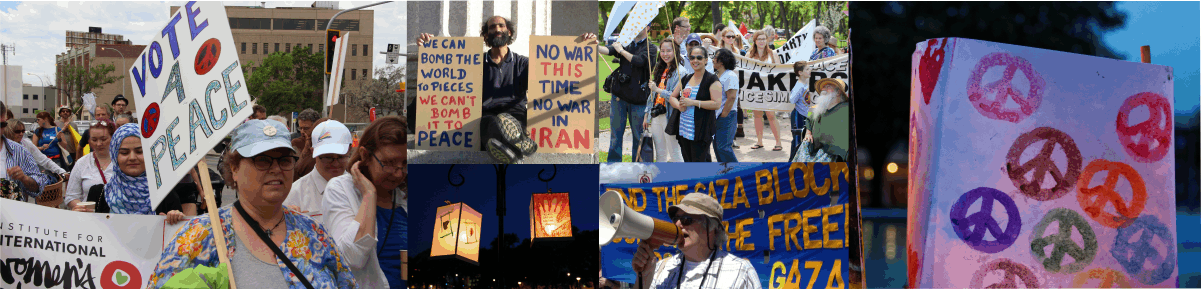
September 26, 2026: At the annual Winnipeg Walk for Peace and Justice through Nuit Blanche. Photo: Glenn Michalchuk
Last year, under pressure from the Trump regime, Canada announced plans to increase military spending to the equivalent of 5% of Gross Domestic Product by 2035. The Parliamentary Budget Officer estimates this ramp up will cost Canadian taxpayers an extra $33.5 billion per year, adding $63 billion to the deficit by 2035.
On average, National Defense Department (DND) spends $25 to $30 billion per year. In 2024 it announced plans for capital expenditures of almost $215 billion over the next 20 years. Even before Trump demanded that Canada and other NATO member states up their military spending, Canada has been planning substantial increases.
Here are some of the big-ticket items Ottawa has announced in recent years.
- Fighter Jets – Announced in 2022, the initial plan announced called for 88 F-35 fighter jets from Lockheed Martin at a sticker price of $19 billion. Since then, Canada has been looking to scale back the F-35 and replace them with less expensive Swedish Gripen fighter jets. The announced price does not include operating costs, which will increase the cost of ownership for 88 F-35s to almost $74 billion over the next 45 years, according to the Parliamentary Budget Office.
- Warships – Ottawa plans to acquire 15 frigates at a cost of $60-80 billion. Once again, this does not include operating and maintenance over the life of the vessels.
- NORAD Modernization – In 2022, Ottawa announced plans to modernize NORAD infrastructure over the next 20 years to the tune of $38 billion. (NORAD is the North American Aerospace Command that we operate with the United States.)
Banking on war
War is big business. Prime Minister Carney was a banker before he became a politician and (unsurprisingly) has established something called the Defense, Security and Resilience Bank (DSRB). A more appropriate name for this institution might be “Mass Murder Incorporated,” because its sole purpose is to fund military spending projects by providing low-cost financing and loan guarantees to governments and military contractors.
Eight countries have formally pledged support: Albania, Belgium, Greece, Latvia, Luxembourg, Romania, Türkiye, Ukraine. None of the major G-7 countries have bought in to date, and it remains to be seen whether the bank will be viable. What is clear though is Canada’s policy direction, which is increasingly militaristic in a world that needs to emphasize peace and cooperation.
Carney is gunning for programs we depend on
To afford the increased military budget, the Carney government has made major program cuts affecting science research, tourism and regional development, foreign aid, climate, journalism and space technology. The government plans to eliminate 40,000 federal public service jobs; 85 federal departments will receive $31 billion less in the upcoming fiscal year compared to the current one.
Just think . . .
Imagine what we could achieve if the billions of dollars Ottawa has earmarked for war were to be spent on fixing our housing crisis, healing our addiction emergency, or helping Canadians adapt to a changing and increasingly dangerous climate. What if some of this money could be redirected to make our health care system more effective? Wouldn’t it be more helpful to have more funding for the technical innovations we will need to build a post-carbon economy?
We are sleepwalking into a militarized future. Canadians need to wake up.