
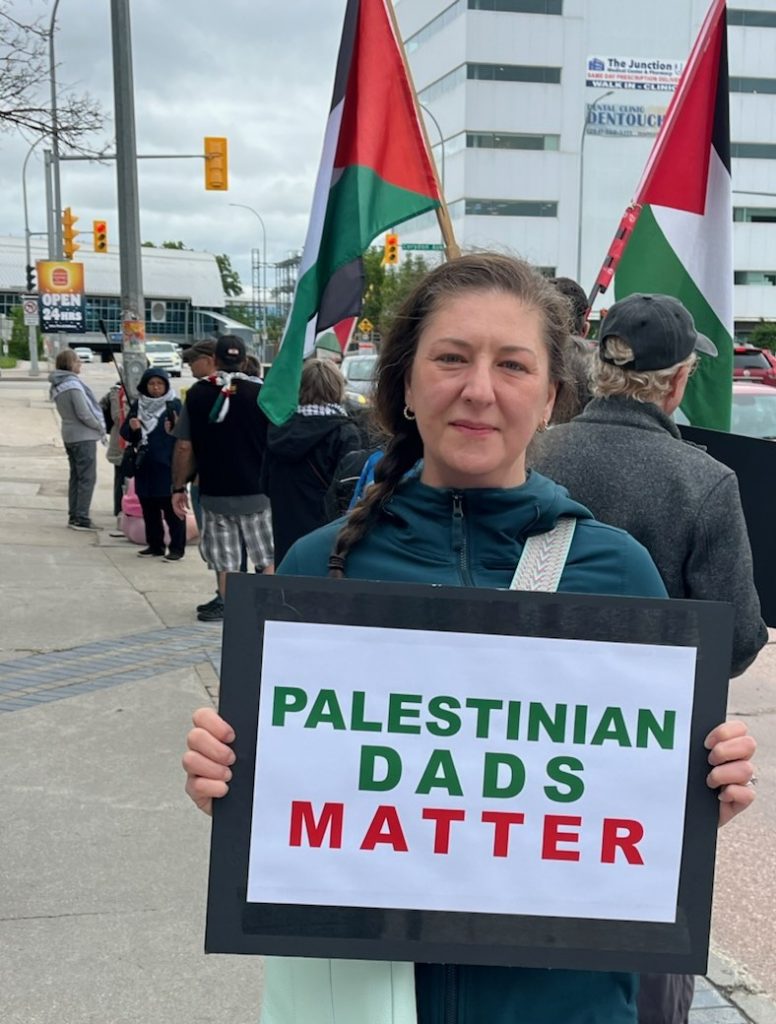
Winnipeg, June 13, 2026: Winnipeggers rallied to honour Palestinian Dads.
by Candice Bodnaruk
“Remember Palestine this Father’s Day” and “Palestinian Dads Matter” were just a couple of the messages on display at a June 13 rally hosted by Peace Alliance Winnipeg that saw dozens of people gather at Confusion Corner to honour Palestinian fathers.
Speakers reflected on the role of Palestinians fathers and two local Palestinian dads also shared their stories. Organizers also created a live exhibit that included a blind-folded Palestinian father and his son. Children’s toys and signs focusing on Palestinian fathers were also part of the display.
According to the Ministry of Social Development in Gaza in April, more than 55,000 Palestinian children have lost their fathers since Oct. 7, 2023 and more than 16,000 women have been widowed.
American writer Frederick Joseph comments that over the past two and a half years there has been little mention of Palestinian men in articles or on social media because since 9/11 western media has dehumanized Palestinians, Arabs, Muslims and brown people.
Joseph says the narrative of suffering in Gaza is incomplete without acknowledging the lives and losses of Palestinian men.
Since October 7, 2023, many children have lost both parents in direct Israeli bombardments on their homes and neighbourhoods. It is estimated that 17,000 children in Gaza are separated from their parents.
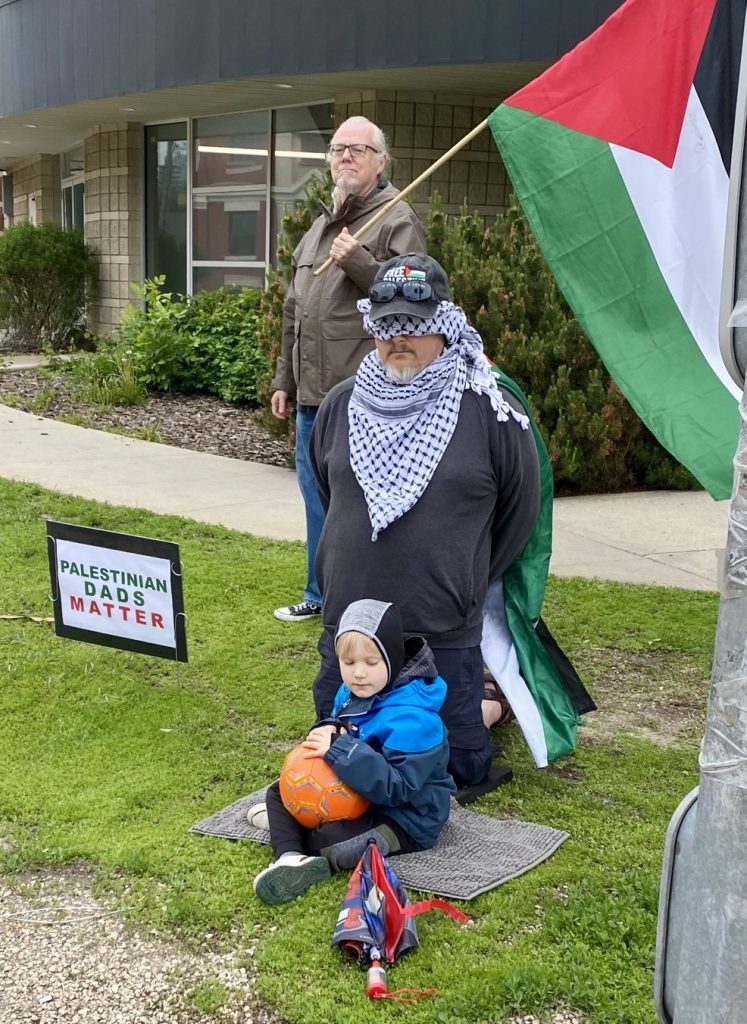
Winnipeg, June 13, 2026: Winnipeggers rallied to honour Palestinian Dads.
Bassam Hozaima, a father of three daughters who has lived most of his life in Winnipeg, spoke of his own father who came to Canada as a refugee from Gaza. Hozaima’s father was born in Zarnuqa, north of Gaza. The village was ethnically cleansed during the Nakba in 1948 and Hozaima’s family ended up in the Nuseirat refugee camp in Gaza.
He recalled as a child living in the camp hearing his family’s stories of how they had to flee their homes and their land and how they would “stay ahead of the killing” and the ethnic cleansing.
Hozaima said his father eventually came to Canada with a group of Palestinian men to find work, which was typical of Palestinian men at the time.
He explained that generation after generation of Palestinian children have grown up with Palestinian fathers have to live with the impact of the genocide
“As a Palestinian father, that’s what I ask, why do our children have to live with this?” he said, noting that through extensive media coverage of the genocide people are finally realizing what’s going on.
He noted that people now see that the fathers in Gaza are no different than any other father around the world.
“They love their children, they care for their children, they grieve, their spirits and their minds are broken when they have to pick their children up from under the rubble and bury them or try to heal them,” he concluded.
Tarek Abdel-Aziz described his own Palestinian experience as “carrying two worlds’ inside himself, one based in Winnipeg and the other part of him is in Ayn al-Hilweh, a refugee camp in South Lebanon.
Abdel-Aziz’s father was born there in 1954, stateless, with no electricity, no water, and no rights. Yet be beat the odds and went on to become the first of his family to attend university.
“His college years were derailed by the civil war in Lebanon and by his activism for a free Palestine,” Abdel-Aziz said, adding his father was a member of the Democratic Front for the Liberation of Palestine in the early 1970s. Abdel-Aziz and his brother were born a decade later in Lebanon.
His father, who passed away in 2022, was a beloved high school math and physics teacher.
“He has always been the flagship and the example that I aspire to become,” Abdel-Aziz said, adding his father taught him and his siblings to never forget where they came from and that each of them carry the Palestinian cause forward in their own way.
He said he sits with one question every day – how does he give his kids a normal life while also ensuring they know exactly where they come from?
“And what does it mean to be Palestinian right now, in this moment of genocide?” he asked.