
General Assembly Marks ‘Grim’ Fourth Anniversary of War in Ukraine, Adopts Text Calling for Ceasefire, as Eleventh Emergency Special Session Resumes
(New York, Feb. 24, 2026) Marking the fourth anniversary of the bloody conflict still raging in Ukraine, the General Assembly today adopted a resolution demanding an immediate, full and unconditional ceasefire, as delegates voiced varying degrees of hope and scepticism over ongoing United States-facilitated peace talks.
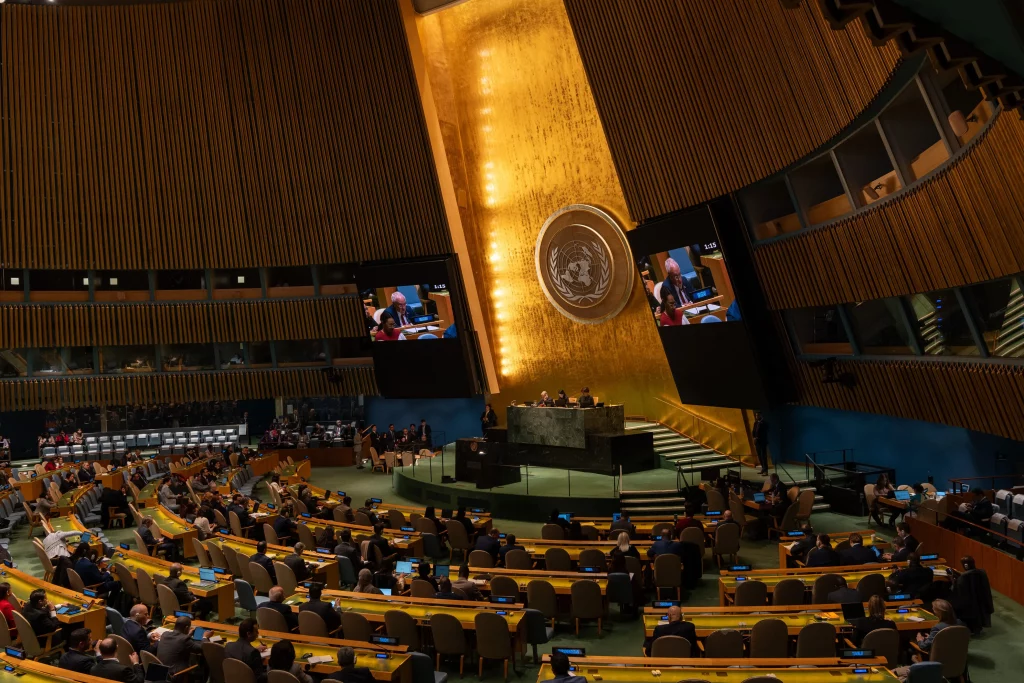
The Assembly’s 193 members met today — exactly four years since the Russian Federation’s invasion of Ukraine — in the latest meeting of its Eleventh Emergency Special Session on Ukraine, which was first convened in February 2022.
They adopted the resolution, titled “Support for lasting peace in Ukraine” (document A/ES-11/L.17), by a recorded vote of 107 in favour to 12 against, with 51 abstentions. By its terms, the Assembly called for an immediate ceasefire between the Russian Federation and Ukraine, the release of all unlawfully detained persons, and the return of all internees and of civilians forcibly transferred or deported, including children.
“This war, initiated by a permanent member of the Security Council in blatant violation of our Charter, continues to inflict untold suffering on the Ukrainian people,” said General Assembly President Annalena Baerbock (Germany), in remarks delivered by Assembly Vice-President Tania Serafim Yvonne Romualdo (Cabo Verde).
Even as peace talks continue, 2025 was the deadliest year for civilians since the start of this invasion, she said. Nearly 4 million people are internally displaced, while homes, healthcare facilities, schools and energy grids have been deliberately targeted and destroyed, leaving people to freeze to death. “This violence spares no one — not mothers or fathers, not grandparents and certainly not children.”
As the world watched in shock, she said, it would have been easy to remain paralyzed. But, the General Assembly — too often dismissed as a body with no real power — chose a different path. With the Security Council deadlocked, the Assembly convened the first meeting of its emergency special session and has since adopted eight resolutions with concrete demands.
“Since the invasion, the General Assembly has remained clear, resolute and unwavering,” she said. “At a time when the UN is under intense scrutiny and the Security Council remains deadlocked, this Assembly has demonstrated its ability to act as the moral voice of the international community.”
Ukraine Decries ‘Deliberate’ Use of Winter as Weapon, as Speakers Call for Just, Comprehensive Peace
“No country in modern history has endured an attack of such gravity,” said Ukraine’s Deputy Minister for Foreign Affairs, who introduced today’s resolution. The Russian Federation seeks to divide the world into spheres of influence and render Ukraine its satellite, she said, but it will not succeed.
Despite many peace efforts, she said, Moscow has demonstrated no genuine willingness to stop its aggression. Between 8 and 15 February, it launched some 1,300 attack drones, more than 1,200 guided aerial bombs and 50 missiles against Ukraine, most of them ballistic. Ukraine, on the other hand, has shown clear readiness to pursue peace, including through extremely difficult compromises.
Painting a vivid picture of life in Ukraine without heat or electricity in frigid winter conditions, she declared: “This is not a military strategy gone wrong, this is a deliberate Russian State policy.” Moscow continues to weaponize winter, cold and darkness to break her nation’s resilience.
Against that bleak backdrop, she urged Member States to vote in favour of the draft resolution before them today, emphasizing that it is no mere “political gesture”, but a vote for justice, peace and in support of the Ukrainian people.
“Today, we mark a tragic anniversary,” said the European Union’s delegate, in its capacity as observer. Moscow continues to intentionally attack civilians and civilian infrastructure, which are war crimes. “Politically, the war has deepened divisions between countries and eroded trust in international institutions and norms,” he said, adding that it has also impacted trade, food security and other critical systems around the globe.
“We want this war to stop,” said the Minister for Foreign Affairs of Latvia, echoing those points. “Russia’s war is an imperial and colonial war,” she added, emphasizing that no one is safe from this ambition – even countries across Africa and the Middle East have been pulled into Moscow’s imperial strategies.
Denmark’s delegate, also speaking for Finland, Iceland, Norway and Sweden, said: “What the Kremlin thought would be a three-day ‘Special Military Operation’ has now entered day 1,461.” Peace in Ukraine must be comprehensive and respect international law, she said, calling for robust security guarantees to prevent the Russian Federation from invading Ukraine again.
“No super-Power wins a war against reality,” said the Czech Republic’s Deputy Prime Minister and Minister for Foreign Affairs. He addressed his remarks directly to his counterpart in Moscow, Foreign Minister Sergei V. Lavrov, asking: “Does this war actually lead to more security for your country?” Even great nations cannot survive wars that have no end. “The strength of a global Power does not lie in its ability to start a foreign war,” but in its ability to end one, he stressed.
“Georgia knows first hand the consequences of occupation,” said that country’s Deputy Minister for Foreign Affairs, noting that Moscow continues its illegal military presence in his country’s Abkhazia and Tskhinvali regions. Indeed, he stressed, Georgia knows the price of peace and will fully support the Ukrainian people.
Moscow Urges Respect for Negotiations
Not every speaker found value in today’s resolution. Many voiced concern that it could further inflame tensions and distract from — or even jeopardize — ongoing peace talks among Ukraine, Russian Federation and the United States.
“Today, when a genuine window of opportunity has opened for a political settlement of the crisis in Ukraine, what we must be talking about, first and foremost, is not declarations but diplomacy,” said the representative of the Russian Federation. With negotiations under way, “this is a moment that calls for quiet restraint and respect for the negotiation process”.
Moreover, she said, it is clear that those who initiated the resumption of the special session are only interested in exerting political pressure on Moscow. The draft calls for a ceasefire, which cannot be viewed as an end in itself. She warned against embracing a “hasty truce” that does not address the root causes of conflict and would only serve as a flawed pause in fighting.
Venezuela’s delegate, on behalf of the Group of Friends in Defence of the UN Charter, echoed concerns over the timing and substance of today’s resolution. He cautioned against any Assembly action “that risks prejudging, disrupting, or politicizing” the ongoing trilateral peace talks, adding that the resolution fails to address the root causes that first sparked the conflict in Ukraine. Lasting peace cannot emerge from selective narratives, the continued supply of arms or the perpetuation of bloc-based politics, he said.
“Ending the war is the right thing to do, but no one is suggesting it will be easy,” said the representative of the United States, who abstained in the vote. Calling on all parties to compromise, “lower the rhetoric” and engage in good faith, she welcomed the call for a ceasefire while warning that some language in the resolution is “likely to distract from ongoing negotiations rather than support discussion of the full range of diplomatic avenues”.
Calls for ‘Balanced’ Security Architecture, Political Courage
“It is important to establish a more balanced, effective and sustainable European security architecture,” said China’s representative, who also abstained. The parties are at a critical stage in their work towards a negotiated settlement. In that vein, he called on the parties to continue building consensus and addressing the root causes of the crisis.
Bahrain’s delegate, speaking for the countries of the Gulf Cooperation Council, said his group also abstained in view of the ongoing diplomatic discussions. The Gulf countries have facilitated various bilateral and trilateral negotiations involving the warring parties, he said, adding that those talks collectively led to the exchange of more than 4,000 prisoners of war.
Similarly, the representative of Türkiye noted that three rounds of direct technical talks were hosted in Istanbul between the parties in 2025 alone. Those meetings paved the way for confidence building and made further dialogue possible. “Our joint efforts with the UN have yielded concrete results, such as the Black Sea Grain Initiative,” he said, adding that Türkiye has also proposed a new ceasefire arrangement prohibiting strikes on energy infrastructure, port facilities and vessels in the Black Sea.
“Only a negotiated political solution can bring this war to an end,” said Brazil’s delegate. “What is required now is a deliberate shift towards dialogue, bridge building and political courage.” Advocating for a negotiated solution, he welcomed all efforts to that end, adding that the perspectives of developing countries are crucial in addressing a conflict of this magnitude, whose effects ripple across the globe.
Reposted from https://press.un.org/en/2026/ga12752.doc.htm.